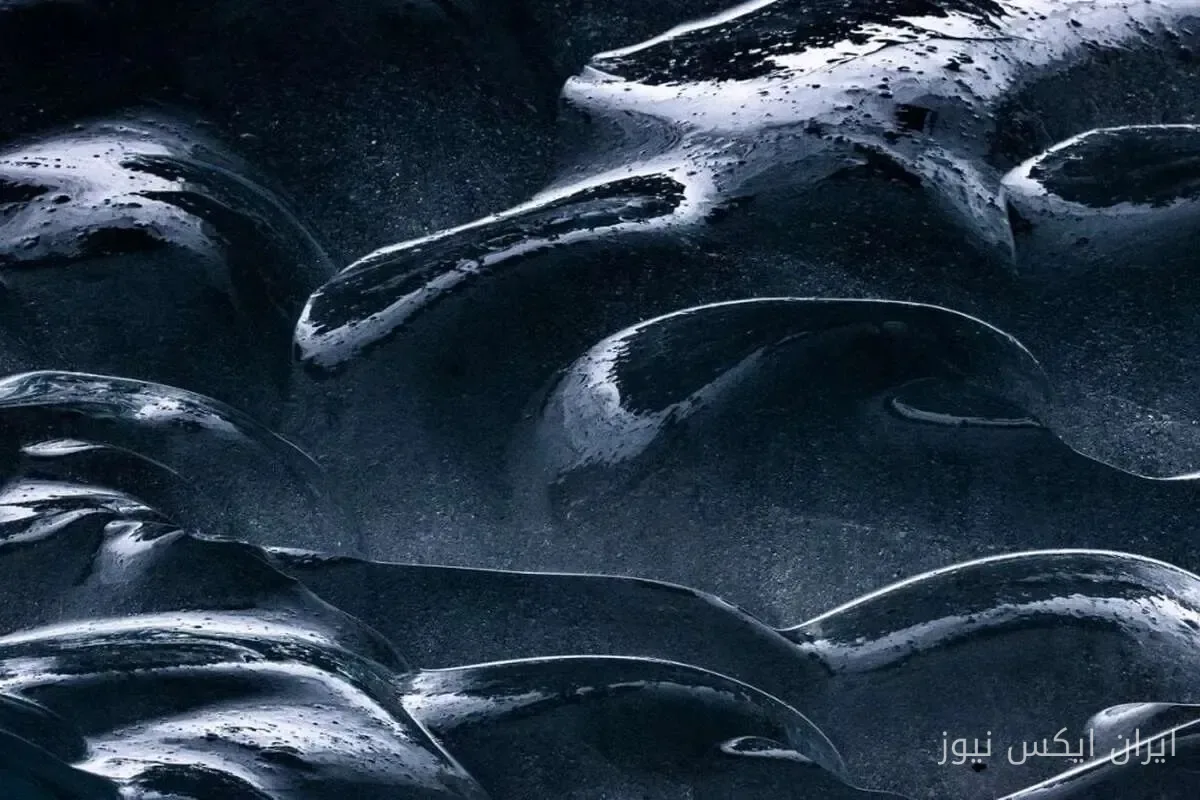
Water exhibits dual behavior at freezing temperatures, and now international researchers have unveiled the hidden mechanism of the transformation of liquid water to solid glass using advanced neutron and particle accelerator technologies.
Unique Properties of Water
Water covers nearly 70 percent of the Earth's surface and constitutes about 60 percent of the human body mass; however, from the perspective of the laws of physics and chemistry, this substance remains one of the most mysterious and unusual compounds in the universe. Water behaves like a dual character; at low temperatures, it takes the familiar form of orderly ice crystals, but under specific conditions, it can transform into a phenomenon known as "glassy water"; a solid form with a completely disordered, amorphous molecular structure lacking crystalline organization.
Read more: Mapna's Entry into the Dump Truck World with a 136-Ton Design
Advanced Research and Its Results
This unusual state of water is not rare in nature; for example, it can be observed in stratospheric clouds in polar regions of the Earth. Additionally, cold-loving organisms also utilize this phenomenon to prevent the formation of sharp ice crystals and, consequently, the rupture of their cell membranes in bone-chilling temperatures. Despite its fundamental importance, the transition of water from a liquid to glassy state has always remained hidden from observational tools due to the rapid crystallization process.
Naturally, when water freezes, it forms hard and orderly crystals. This process occurs at temperatures around minus 45 degrees Celsius. At temperatures lower than this threshold, scientists encounter a dark and unknown area known as the "thermodynamic no man's land," which is extraordinarily difficult to investigate experimentally. Previous hypotheses suggested that the glassy transition of bulk water occurs around minus 135 degrees Celsius, but the inevitable formation of ice crystals prevented direct observation of this phenomenon.
According to a recently published article, an international group of researchers has managed to break this ancient barrier inspired by natural tricks. Physicists trapped very small amounts of water, only a few molecules thick (less than one billionth of a meter), between two lipid layers made of transparent fatty alcohol molecules called "phytantriol." These layers maintain their structural stability and liquid flexibility in the cold, preventing the formation of a crystalline ice network.
This pioneering research project was led by Rafael Metzenga from the prestigious Zurich Institute of Technology in collaboration with scientists from the Australian Nuclear Science and Technology Organization. The research team employed a combination of advanced computer simulations and atomic precision particle beams. In these experiments, the small-angle and wide-angle X-ray scattering (SAXS/WAXS) beamline from the Ansto synchrotron particle accelerator was used to map the geometric structure of molecules trapped in the lipid membrane.
The obtained data revealed that the glassy transformation of water occurs over an astonishing time scale spanning six orders of magnitude, from microseconds to picoseconds. A significant reduction in molecular mobility begins in the range of minus 21 to minus 35 degrees Celsius, and water gradually tends to slow down. Then, the static structural transition to a complete and disordered glassy state is completed between minus 64 and minus 74 degrees Celsius. Finally, with further drops in temperature, this glassy layer begins to crack like a brittle piece of candy.
This achievement not only unravels one of the fundamental mysteries of the physics of matter but also paves the way for significant industrial and biomedical transformations. Researchers emphasize that these findings have direct applications in phenomena related to water at the nanoscale and ultracold, including the enhancement of tissue and organ freezing technologies without cellular damage and improving deep freezing methods for food and pharmaceuticals. Now it remains to be seen whether this scientific step can transform the storage of biological samples and create a new quality for the production of amazing products.
Read more: Specter R42; The Supercar Lost in History · Tehran University President: Faculty Salary Restoration Finalized!