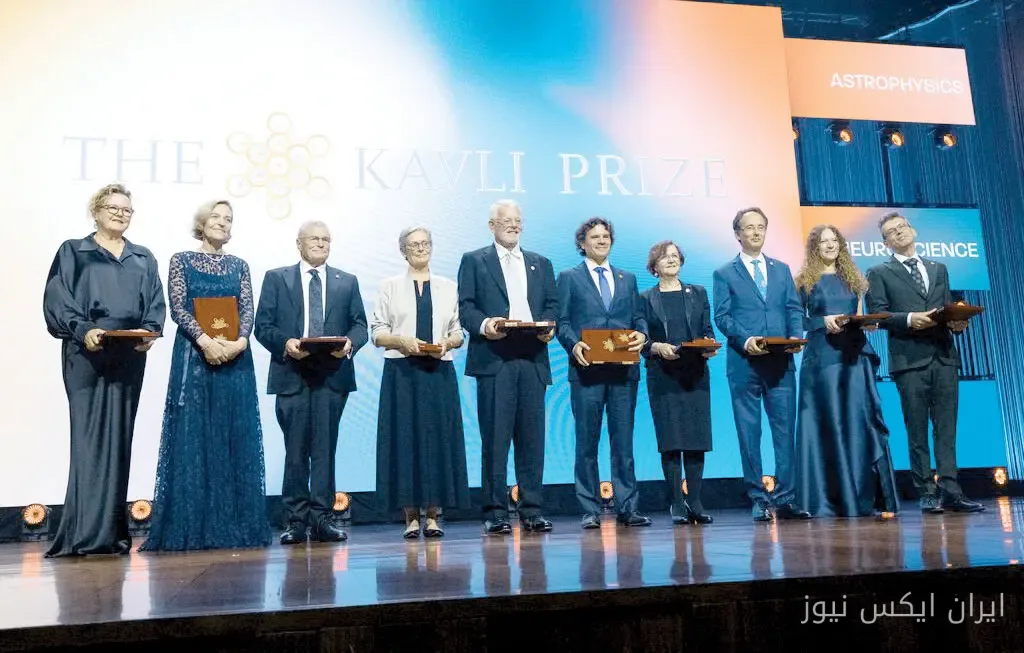
Mohammad-Hossein Jahanpanah: On June 10 of this year, the Norwegian Academy of Sciences announced 10 scientists from three continents and 9 nationalities as the winners of the Kavli Prize 2026. This award is held every two years in three fields: astrophysics, nanoscience, and neuroscience, during which the winners of each section share a cash prize of one million dollars, a gold medal, and a certificate of honor.
Meanwhile, the death of Harald V (King of Norway) on August 28 of this year, just before the event, somewhat overshadowed the atmosphere and details of its programs. However, ultimately all 10 researchers received their medals on the stage of the Oslo Concert Hall from Jonas Gahr Støre, the Prime Minister of Norway.
Read more: Shahid Beheshti University Announces Renovated Dormitory Capacity
History of the Kavli Prize
The Kavli Prize originally refers to Fred Kavli, a Norwegian-American engineer and entrepreneur, and it has been around for nearly two decades. Kavli, who was born in 1927 in the small village of Årsfjord in Norway, emigrated to America after studying physics at the Norwegian Institute of Technology and founded the Kavlico Company in Los Angeles in 1958. This company became one of the largest suppliers of industrial sensors in the world, and its products were even used in projects such as the SR-71 Blackbird reconnaissance aircraft and NASA's space shuttles.
After selling his company in 2000, Kavli established the Kavli Foundation, and it was through this foundation that the Kavli Prize was born in 2005 through a partnership between the Kavli Foundation, the Norwegian Academy of Sciences, and the Ministry of Education and Research of the country. The first edition of this prize was awarded in 2008 to seven scientists from different countries. The winners of each edition are selected by the Norwegian Academy of Sciences based on recommendations from three international committees composed of prominent scientists in each field.
Winners of Each Section and Scientific Achievements
This year, the Kavli Prize in astrophysics was awarded to Blokurov from the University of Cambridge in the UK, Amina Helmi from the University of Groningen in the Netherlands, and Rodrigo Ibata from the National Center for Scientific Research in France and the University of Strasbourg. These researchers demonstrated that the Milky Way, contrary to the long-held belief that it is a calm and stable galaxy, has swallowed smaller neighboring galaxies over its billions of years of existence and has grown larger from their remnants.
The starting point of this research dates back to 1994 when Rodrigo Ibata and his colleagues discovered the Sagittarius dwarf spheroidal galaxy. In the following years, Ibata found the trace of this galaxy in the form of a massive stream of stars using data from the Sloan Digital Sky Survey. This stellar stream later became known as the Sagittarius tidal stream and became one of the important pieces of evidence for demonstrating the gradual merging of small galaxies with the Milky Way.
In the nanoscience section, the Kavli Prize was awarded to Eva Andrei from Rutgers University, Pablo Jarillo-Herrero from the Massachusetts Institute of Technology, and Alan MacDonald from the University of Texas at Austin. These three scientists, through their fundamental research, showed that a very small change in the arrangement of very thin layers of a material can significantly alter its behavior.
Read more: Rail Fleet Repair: A New Step for Shahroud in the Development of the Transport Industry · American Cheetah, a Felid That Is Not a Cheetah