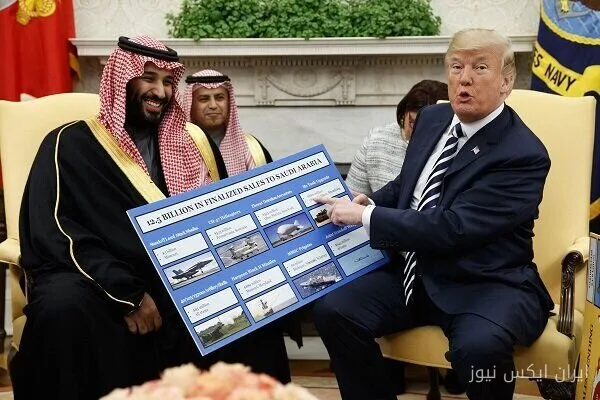
Mohammed bin Salman, the Crown Prince of Saudi Arabia, has made two requests for direct U.S. airstrikes against Houthi positions as Ansar Allah forces advance towards the coastal city of Mokha and near the strategic Bab-el-Mandeb Strait. Donald Trump, the President of the United States, rejected both requests, and it has been announced that Washington currently has no plans for direct military intervention. Instead, the U.S. only provides targeting intelligence and data to the Saudis. It is worth noting that approximately 200 American troops are also present in Saudi Arabia, playing advisory and non-combat roles.
Lack of Security Guarantees from Foreign Agreements
This event, amid escalating conflicts in Yemen and the increasing control of Ansar Allah over vital trade and oil export routes, once again demonstrates that security agreements and collaborations with the U.S. do not guarantee stability and security. The U.S. has prioritized addressing multiple failures in its battle with Iran and is seeking a way to extricate itself from the quagmire of conflict with Iran and the Strait of Hormuz, avoiding the opening of a new military front. Even close allies and major buyers of American weapons, such as Saudi Arabia, face repeated rejections during critical moments.
Read more: Azizi: Increasing Resilience is the Way to Counter Domination
Iran's Experience and Indigenous Power
Iran's experience in its recent confrontations with the U.S. and the Zionist regime has clearly proven this reality. In the twelve-day war of Khordad 1404 and then the forty-day war in Esfand of last year and Farvardin of this year, as well as the subsequent conflicts, extensive air and missile attacks were carried out against Iran's military, nuclear, and defense infrastructure. If Iran's defensive capability were dependent on agreements, imported equipment, or direct support from other countries, none of these would have come to aid during those critical conditions, and the country would not have been able to withstand the aggression.
Iran's indigenous deterrent and defensive power includes air defense systems, ballistic and cruise missiles, drones, and a resilient command structure that enabled response, territorial integrity maintenance, and prevention of defensive collapse. These experiences remind us of a fundamental lesson: the resistance and sustainable security of a country can only be guaranteed when it is formed from within the nation and based on indigenous capabilities.
The U.S., as a power that adjusts its agreements based on momentary calculations of its national interests, is not a reliable country for ensuring the security of others. Countries that tie their security to such agreements face a support vacuum in critical days, just as the repeated requests from the Saudis went unanswered.
In contrast, Iran's model shows that long-term investment in indigenous defensive capabilities, the development of independent military technologies, and reliance on human resources and national will are the only ways to create real deterrence. It was this inner strength that came to the country's aid in recent wars and prevented foreign aggression from leading to a security collapse. In the chaotic regional environment, the main lesson is clear: security is not imported; security is built.
Read more: Saeed Jalili spoke of the Treaty of Hudaybiyyah · Postponement of the Muscat regional meeting at Saudi Arabia's request